
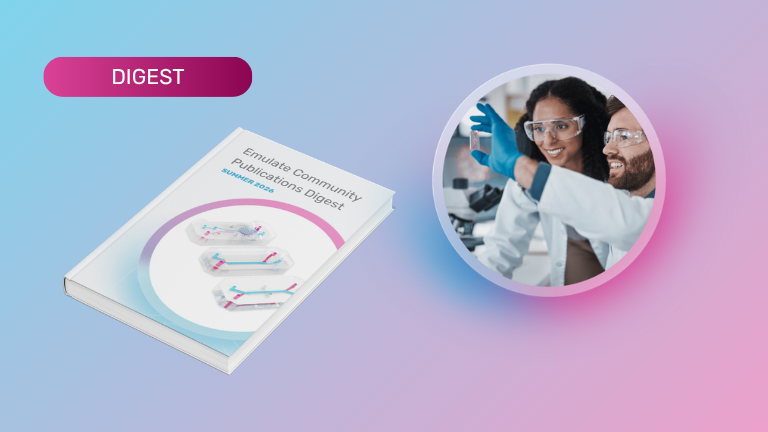
Emulate Community Publications Digest: Winter 2026 Issue

With over 130 peer-reviewed publications across 30+ organ models, Emulate Organ-Chips are empowering researchers to make game-changing scientific breakthroughs! Download this digest to easily explore all publications related to your field of research, or to just learn more about how the technology itself is developing.

New this quarter:

Bone (Metastasized Breast Cancer)

  • Multi-omics qualification of an organ-on-a-chip model of osteolytic bone metastasis

Brain

  • A guided approach to establish a functional humanized Brain-on-a-Chip microfluidic model of the neurovascular system

Intestine

  • Gene expression profiling reveals enhanced nutrient and drug metabolism and maturation of hiPSC-derived intestine-on-chip relative to organoids and Transwells
  • Establishing the human Duodenum-Chip as a surrogate for effective human permeability: In vitro and in silico assessment

Liver

  • Challenges and solutions in measuring commonly used biomarkers for drug-induced liver injury in a Liver-On-A-Chip platform

Lung

  • Lung microphysiological system validates novel cell therapy for Acute Respiratory Distress Syndrome
  • Revealing the impact of Pseudomonas aeruginosa quorum sensing molecule 2’-aminoacetophenone on the human bronchial-airway epithelium and pulmonary endothelium using a human airway-on-a-chip

Vasculature

  • Human coronary artery tri-culture organ-chip recapitulates anti-inflammatory effect of pulsatile wall strain
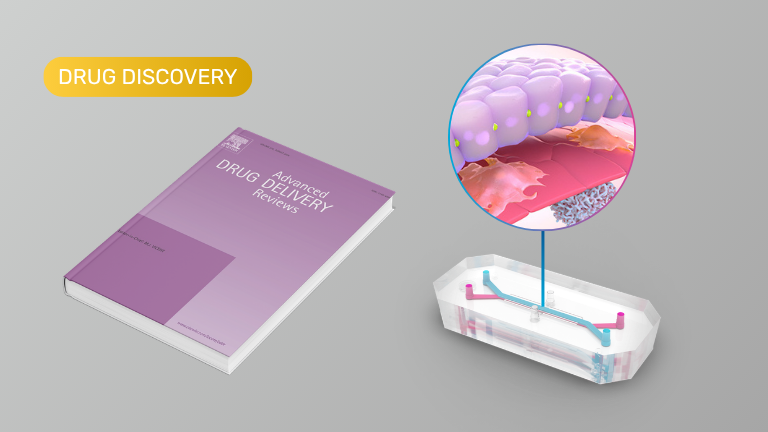
A novel organ-chip system emulates three-dimensional architecture of the human epithelia and the mechanical forces acting on it

ScienceDirect (2021)

Abstract

Read this publication to learn how researchers built a prototype Chip-A1 Accessible Chip to address many of the challenges associated with the Organ-on-a-Chip technology, including incorporation of a tissue-specific extracellular matrix gel seeded with primary stromal cells, to reproducing the architectural complexity of tissues by micropatterning the gel, to extracting the gel for H&E staining.

Reconstituting Cytoarchitecture and Function of Human Epithelial Tissues on an Open-Top Organ-Chip

Organ Model: Lung (Alveolus) & Skin

Application: Model Development

Abstract: Nearly all human organs are lined with epithelial tissues, comprising one or multiple layers of tightly connected cells organized into three-dimensional (3D) structures. One of the main functions of epithelia is the formation of barriers that protect the underlining tissues against physical and chemical insults and infectious agents. In addition, epithelia mediate the transport of nutrients, hormones, and other signaling molecules, often creating biochemical gradients that guide cell positioning and compartmentalization within the organ. Owing to their central role in determining organ-structure and function, epithelia are important therapeutic targets for many human diseases that are not always captured by animal models. Besides the obvious species-to-species differences, conducting research studies on barrier function and transport properties of epithelia in animals is further compounded by the difficulty of accessing these tissues in a living system. While two-dimensional (2D) human cell cultures are useful for answering basic scientific questions, they often yield poor in vivo predictions. To overcome these limitations, in the last decade, a plethora of micro-engineered biomimetic platforms, known as organs-on-a-chip, have emerged as a promising alternative to traditional in vitro and animal testing. Here, we describe an Open-Top Organ-Chip (or Open-Top Chip), a platform designed for modeling organ-specific epithelial tissues, including skin, lungs, and the intestines. This chip offers new opportunities for reconstituting the multicellular architecture and function of epithelial tissues, including the capability to recreate a 3D stromal component by incorporating tissue-specific fibroblasts and endothelial cells within a mechanically active system. This Open-Top Chip provides an unprecedented tool for studying epithelial/mesenchymal and vascular interactions at multiple scales of resolution, from single cells to multi-layer tissue constructs, thus allowing molecular dissection of the intercellular crosstalk of epithelialized organs in health and disease.