
Organ Model: Lung (Alveolus)
Applications: Infectious Disease
Highlights
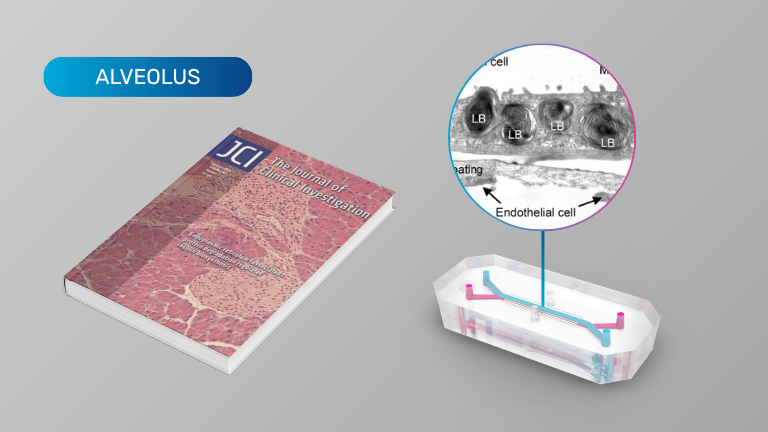
An Alveolus Lung-Chip was used to create a human pneumonia-on-a-chip model that recapitulates key features of ventilator-associated pneumonia (VAP), including an air–liquid interface, vascular flow, and cyclic mechanical stretch. The chip supported co-culture of human pulmonary microvascular endothelial cells with either primary or organoid-derived alveolar epithelial cells, enabling differentiation into AT1- and AT2-like cells and formation of a tight epithelial–endothelial barrier. By applying physiological (5%) or hyperphysiological (10%) cyclic strain, the authors modeled mechanical ventilation–like forces and showed that higher strain impaired barrier integrity and broadly altered gene expression. Upon infection with Pseudomonas aeruginosa, increased mechanical strain exacerbated bacterial translocation and barrier disruption, demonstrating the chip’s ability to model early, force-dependent mechanisms of VAP.